

Tips to Choose the Best Accounting Tool for Small Businesses
Octa Accountants
7 Min Read

April 6, 2026

Accounting for Small Businesses
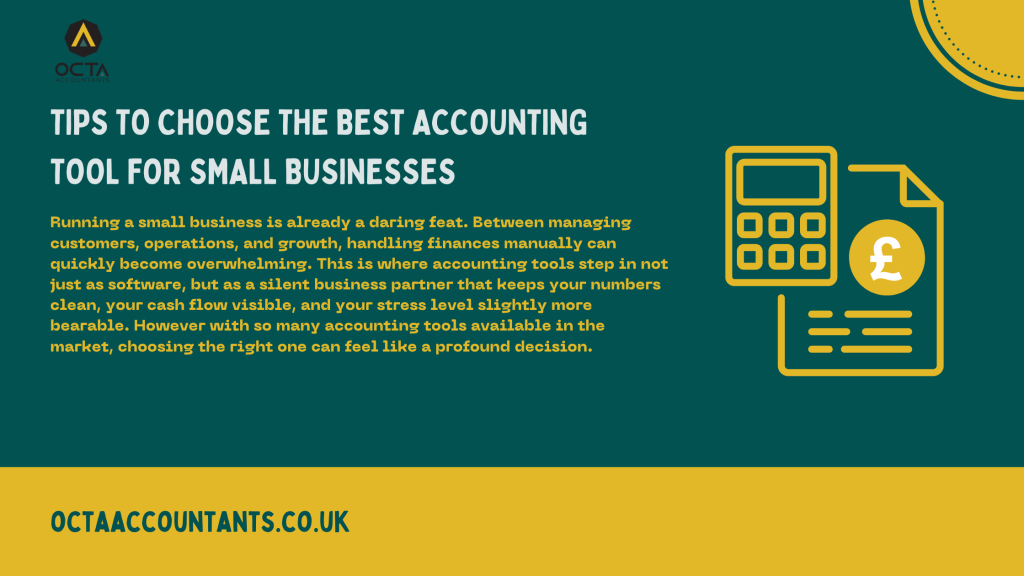
Running a small business is already a daring feat. Between managing customers, operations, and growth, handling finances manually can quickly become overwhelming. This is where accounting tools step in not just as software, but as a silent business partner that keeps your numbers clean, your cash flow visible, and your stress level slightly more bearable. However with so many accounting tools available in the market, choosing the right one can feel like a profound decision.
Some tools promise automation while others highlight affordability and a few boast advanced features you may not even need yet. Let’s break down some practical tips to help you choose the best accounting tool for your small business, ensuring you invest in something that truly supports your growth.
Also Read: 7 Best Blogs For Accountants To Follow
Why Choosing the Right Accounting Tool Matters
Before we dive into tips, let’s focus on how the right accounting tool is not just about tracking numbers but it directly impacts your financial accuracy, tax compliance, decision-making and business scalability. Modern accounting software helps automate tasks like invoicing, expense tracking, and financial reporting, saving time and reducing human error . It also gives real-time insights into your business performance, helping you make smarter decisions faster .
- Understand Your Business Needs First: Take a step back and evaluate your own business before you start to compare tools. Not every business needs every feature. In fact, overpaying for unnecessary features is one of the most common mistakes. The best approach is simple:
Choose a tool that solves your current problems but can also grow with your business.
- Look for Essential Features: Every accounting tool will try to impress you with features. Ignore the noise and focus on what actually matters. Important features include invoicing and billing, expense tracking, bank integration, financial reporting, tax calculation and compliance. These features form the backbone of any reliable accounting system. Good software automates these processes, reducing manual data entry and saving valuable time .
- Prioritize Ease of Use: Your accounting tool should feel simple, intuitive, and easy to navigate. If a platform requires extensive training just to send an invoice, it’s already working against you. Always remember that user friendly tools will reduce errors, save time and increase productivity. Many modern tools are designed specifically for non-accountants, making financial management accessible even for beginners.
- Choose Cloud-Based Accounting Software: If your accounting tool is tied to one device, you’re already limiting your business. This is where cloud based accounting software comes in as they help you access data anytime, anywhere, collaborate with accountants in real-time and keep data automatically backed up. They also operate on subscription models, reducing upfront costs and maintenance requirements. Plus, they scale easily as your business grows, allowing you to add features or users without disruption. In today’s fast-paced environment, cloud accounting isn’t a luxury but the standard.
- Check Integration Capabilities: Your accounting tool should not work in isolation. It should connect smoothly with payment gateways, CRM systems, e-commerce platforms and payroll systems. For example, tools like QuickBooks, Xero, and Zoho Books are known for integrating with hundreds of apps, streamlining operations across your business. The more connected your systems are, the less manual work you have to do.
- Consider Scalability for Future Growth: The tool you choose today should still work for you a year from now. As your business grows, your accounting needs will evolve to accommodate more transactions, more users and more complex reporting. Switching accounting software later can be time-consuming and risky. That’s why it’s better to choose a scalable solution from the start. Ideally business owners of all scales look for tools that offer multiple pricing tiers, allow feature upgrades and support business expansion.
- Evaluate Pricing vs Value: Budget matters but that does not mean you need to cut expenses on the cost of your financial health. Free or low cost tools may initially look promising but lack advanced reporting, automation and customer support. Accounting software ultimately pays for itself by improving efficiency and accuracy.
- Ensure Compliance with Local Regulations: If you’re running a business in the UK, compliance is non-negotiable. Your accounting tool should support HMRC requirements, Making Tax Digital (MTD) compliance and VAT calculations and submissions. Many modern tools are designed with compliance in mind, helping businesses avoid penalties and stay aligned with tax regulations .
- Look for Automation Features: Automation is where accounting tools truly shine. Instead of manually entering data, good software can not only import bank transactions automatically but also generate recurring invoices, send payment reminders and categorize expenses. Automation reduces human error and speeds up processes significantly, freeing up time for more important tasks .
- Check Customer Support and Reviews: Even the best tools can run into issues. When they do, reliable customer support becomes crucial which is why you should always look for live chat or phone support, tutorials and positive user reviews. Real user experiences often reveal what marketing pages don’t. Furthermore most accounting tools offer free trials so use them to explore the dashboard, create sample invoices and test reporting features.
Also Read: Will accountants be replaced by AI?
Concluding Thoughts
Choosing the best accounting tool for your small business isn’t about picking the most popular option. It’s about finding the one that fits your business like it was made for it. It is essential to focus on your needs, essential features, ease of use, scalability and compliance. The right tool will not just manage your finances, it will empower your business to grow with confidence and clarity.
Ready to Simplify Your Accounting?
Here at Octa Accountants, we understand that choosing and managing accounting tools can feel overwhelming. Whether you’re a startup, freelancer, or growing business, our expert team helps you manage your finances efficiently while staying fully compliant with UK regulations. Contact us today and take the first step towards stress-free accounting.
Navigating the complexities of eCommerce accounting can be overwhelming, but you don’t have to do it alone. At Octa Accountants, we specialize in helping businesses streamline their financial processes, manage inventory, and stay compliant with tax laws. Whether you’re a small business or a growing enterprise, our expert team is here to ensure your finances are in perfect order—so you can focus on scaling your business.
About Us
Octa Accountants is a one-stop accounting firm that offers a wide range of finance management services.
Our Blogs
Top Accounting Trends Shaping Businesses in 2026
Top Accounting Trends Shaping Businesses in 2026 Octa Accountants 7 Min Read April 26, 2026 Accounting Trends 2026 Accounting isn’t what it used to be in the last few decades.…
Moving to a 100% Paperless Accounting System in 2026
Moving to a 100% Paperless Accounting System in 2026 Octa Accountants 7 Min Read April 22, 2026 Paperless Accounting Paper used to mean control. Filing cabinets, printed invoices, stacked receipts,…
How to Stay Compliant with Changing Tax Laws in 2026
How to Stay Compliant with Changing Tax Laws in 2026 Octa Accountants 7 Min Read April 18, 2026 Tax Laws 2026 Tax laws have a way of changing quietly, constantly…