

Top 5 Hidden Tax Deductions Small Businesses Miss Every Year

Octa Accountants

7 Min Read

Jan 14, 2026

Tax Deductions
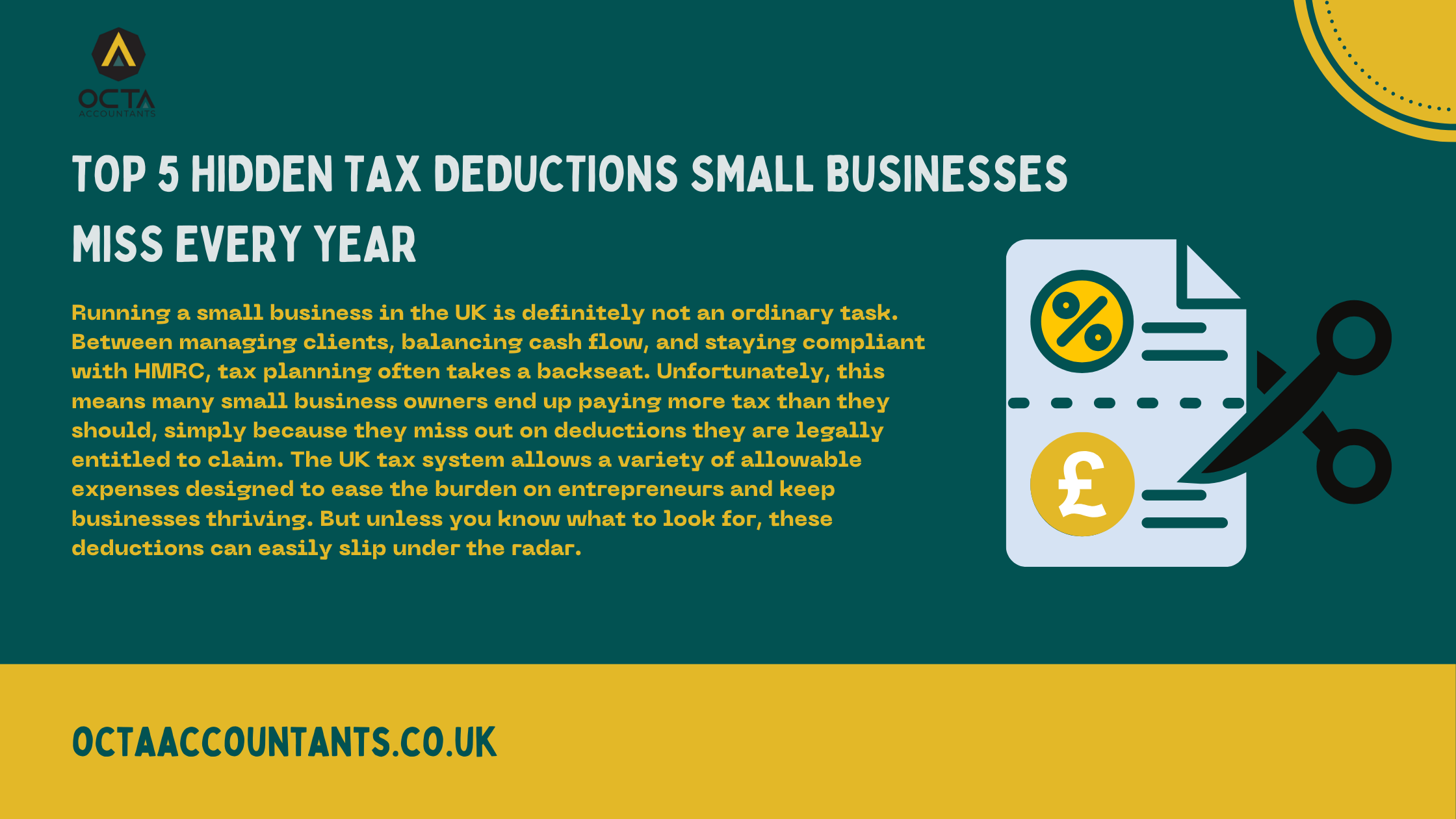
Running a small business in the UK is definitely not an ordinary task. Between managing clients, balancing cash flow, and staying compliant with HMRC, tax planning often takes a backseat. Unfortunately, this means many small business owners end up paying more tax than they should, simply because they miss out on deductions they are legally entitled to claim. The UK tax system allows a variety of allowable expenses designed to ease the burden on entrepreneurs and keep businesses thriving. But unless you know what to look for, these deductions can easily slip under the radar.
Also Read: 7 Best Blogs For Accountants To Follow
To empower small businesses read below and uncover the top five hidden tax deductions that you might miss as we explain how you can take full advantage of them to reduce your tax bill and improve your bottom line.
- Home Office Expenses: Many small business owners and sole traders operate from home, but many among them fail to claim the relief they deserve. HMRC allows you to deduct a portion of your household costs if you use your home as a place of business. Starting from a proportion of your electricity, gas, and water bills and broadband and phone expenses to the council tax and mortgage interest or rent and maintenance and repairs for the part of your home used for business can be all claimed. You can either use HMRC’s simplified flat rate method or calculate the exact proportion based on your home’s floor space and business usage. For many sole traders, home office costs can save hundreds of pounds in tax each year. But since it requires a bit of record keeping, many simply skip it and over time, that missed deduction adds up significantly.
- Training and Development Costs: Another overlooked deduction relates to professional training. If you attend a course, workshop, or seminar to improve your existing business skills, HMRC allows you to treat those costs as an allowable expense. CPD courses, software training to enhance existing skills and seminars, webinars, or industry specific workshops are a few examples that qualify for this. However you need to consider that the training must be relevant to your current business. In today’s competitive market, upskilling is vital. Claiming training costs not only helps you grow but also lowers your tax liability.
- Travel Costs: Business related travel is another area where UK small businesses miss deductions. If you use your personal vehicle for work, you may be entitled to claim mileage allowances or actual running costs. There are two main methods for claiming this. Through the mileage method HMRC allows 45p per mile for the first 10,000 miles, and 25p per mile thereafter. Whereas using the actual cost method you can claim a proportion of running costs such as fuel, insurance, servicing, and depreciation. Other travel costs that count include train and bus fares for business journeys, parking fees and hotel stays when travelling for work. For contractors, consultants, and mobile businesses, travel deductions can make a huge difference. Yet, many fail to keep accurate mileage logs or receipts which makes them miss out on significant relief.
- Marketing and Advertising: Most small businesses remember to claim obvious marketing expenses like website hosting or business cards. But many don’t realise how broad this category can be under HMRC’s rules. A few common examples of deductible marketing expenses include social media advertising, google ads or PPC campaigns, promotional material, sponsorships of local events and the costs of maintaining and optimising your business website. Marketing is essential for growth, and every penny counts. By correctly categorising and claiming all allowable marketing costs, you not only reduce tax but also reinvest in your business more effectively.
- Subscriptions, Memberships, and Professional Fees: This is perhaps the most hidden deduction of all. Many small business owners don’t realise that subscriptions and memberships can qualify as legitimate business expenses. You can claim membership fees for professional bodies, trade journals, magazines, and digital subscriptions, software subscriptions essential for your work and union or association fees, if directly related to your industry. These costs often fly under the radar because they don’t feel like huge expenses initially. But combined, they add up over the year and they’re fully deductible if they’re necessary for your trade.
Also Read: Will accountants be replaced by AI?
Concluding Thoughts
Individually, these five categories might seem small. But when you put them together, the savings can be substantial reaching to potentially £4,000–£5,000 in tax-deductible expenses per year which could lower your taxable income significantly and free up money to reinvest in your business. Never make the mistake of not keeping proper records as HMRC would require evidence. Also do not mix personal and business expenses. It is best to keep them separate for claiming deductible expenses. The UK tax system may feel complex, but it also provides opportunities for business owners to save. By understanding and claiming these hidden deductions from home office costs to training, travel, marketing, and subscriptions you can legally reduce your tax bill and save up more money. Small businesses often operate on tight margins. Missing these allowances means handing over more money to HMRC than necessary.
Reach out to us!
Here at Octa Accountants, we specialise in helping UK small businesses uncover hidden savings and stay fully compliant with HMRC. Don’t wait until tax season to discover what you’ve missed and let us help you plan ahead. Contact us today to book a free consultation and find out how much you could save on your next tax return!
Navigating the complexities of eCommerce accounting can be overwhelming, but you don’t have to do it alone. At Octa Accountants, we specialize in helping businesses streamline their financial processes, manage inventory, and stay compliant with tax laws. Whether you’re a small business or a growing enterprise, our expert team is here to ensure your finances are in perfect order—so you can focus on scaling your business.
About Us
Octa Accountants is a one-stop accounting firm that offers a wide range of finance management services.
Our Blogs
How to Automate VAT Returns Without Losing Control
How to Automate VAT Returns Without Losing Control Octa Accountants 7 Min Read Feb 2, 2026 UK VAT Returns Managing VAT returns is one of those tasks that every business…
Year-End Accounting Checklist for E-Commerce Businesses in the UK
Year-End Accounting Checklist for E-Commerce Businesses in the UK Octa Accountants 7 Min Read Jan 21, 2026 UK Accounting Checklist Running an e-commerce business in the UK can be both…
Top 5 Hidden Tax Deductions Small Businesses Miss Every Year
Top 5 Hidden Tax Deductions Small Businesses Miss Every Year Octa Accountants 7 Min Read Jan 14, 2026 Tax Deductions Running a small business in the UK is definitely not…